
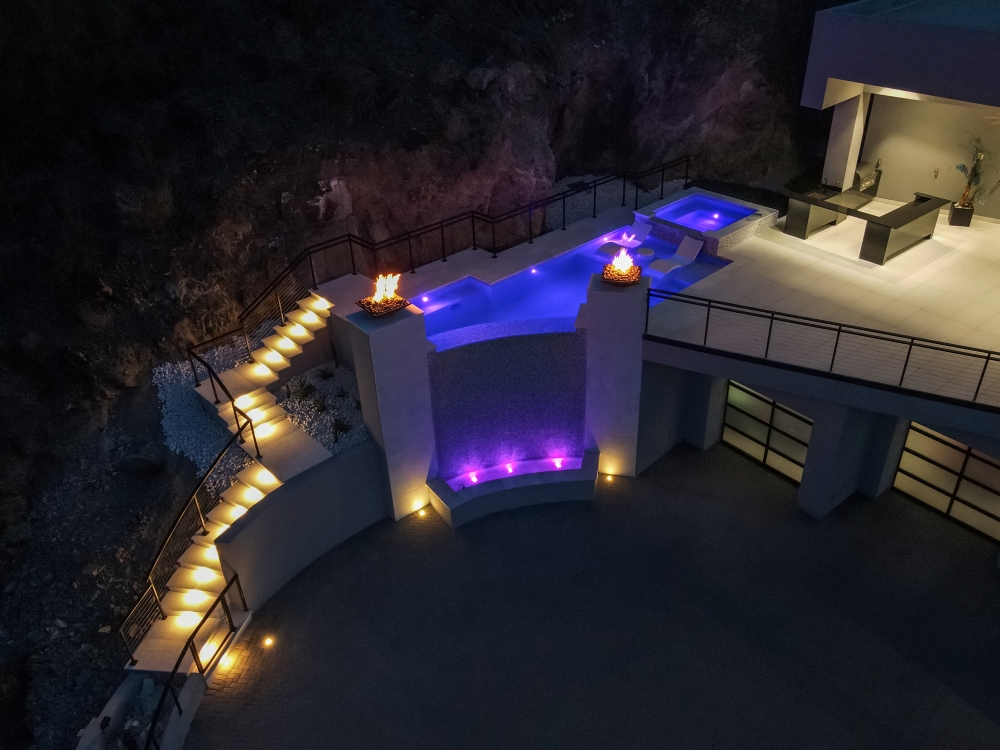
Planning luxury pools in Scottsdale and Paradise Valley requires more than a great design — it demands engineering expertise, permit strategy, and a builder who understands complex terrain. This guide covers everything you need to know about building a high-end pool and outdoor living environment in Arizona's most exclusive communities, from hillside construction to negative edge design to navigating the Hillside Building Committee.
Your Paradise Valley estate deserves more than standard pool construction. When your property commands panoramic mountain views and challenging terrain, building a luxury pool requires specialized engineering expertise—not generic installation methods.
At Innovative Custom Pools, we're licensed Arizona General Contractors engineering complex hillside projects across Paradise Valley and North Scottsdale since 2010. We coordinate structural engineering, Hillside Building Committee approvals, drainage systems, and multi-tiered retaining walls as an integrated scope—eliminating the coordination gaps that plague volume builders relying on subcontractors.
Our hillside portfolio includes negative edge installations on 30+ degree slopes, advanced grading solutions for caliche-heavy terrain, and water features engineered to withstand Arizona's extreme temperature swings. We pull permits, manage inspections, and guarantee structural integrity where others cut corners.
Your backyard's complexity isn't a liability—it's an opportunity for a truly custom creation.
Building on flat lots follows predictable patterns. Hillside construction demands custom solutions for every project. Paradise Valley's dramatic elevation changes, rocky substrate, and strict Hillside Building Committee oversight require licensed general contractor expertise that coordinates multiple engineering disciplines simultaneously.
Standard pool contractors outsource retaining walls to separate subcontractors, creating coordination failures where walls settle independently from pool shells. We engineer retaining structures as integrated load-bearing components of the complete pool system—preventing the cracking, leaning, and water intrusion that plague improperly coordinated projects.
The result: luxury pools that perform flawlessly for decades, not just pass initial inspections.
Paradise Valley's natural slopes require retaining walls reaching 10–20+ feet in height to create level pool platforms. Standard residential contractors treat walls as separate projects; we engineer them as structural components bearing the full weight of pool water, equipment, and surrounding soil pressure.
Our licensed general contractor status means we coordinate reinforced concrete specifications, geotechnical analysis, and municipal inspection protocols—ensuring walls withstand Arizona's freeze-thaw cycles and monsoon runoff without cracking or failure. Properly engineered retaining walls account for lateral earth pressure, hydrostatic pressure behind walls, and thermal expansion coefficients in desert climates.
We specify #5 rebar at 16-inch centers with proper embedment depth, not the minimum code requirements volume builders use to reduce costs. This engineering rigor prevents the wall bowing, cracking, and catastrophic failure homeowners experience 5-10 years post-construction when shortcuts were taken.
Paradise Valley's ancient seabed foundation often contains caliche—a cement-like calcium carbonate layer sitting 2–6 feet below surface that standard excavators cannot penetrate. This naturally occurring concrete forms through thousands of years of mineral deposits and can exceed 3-4 feet in thickness across entire building envelopes.
We employ specialized rock hammering equipment and experienced operators familiar with caliche identification and removal protocols. Our crews recognize the difference between removable caliche layers and load-bearing bedrock that provides ideal foundation support. This expertise prevents the hidden $5,000–$20,000 cost surprises typical homeowners face mid-project when contractors encounter unexpected subsurface conditions.
Proper caliche removal ensures clean excavation to specified depths, allowing accurate placement of reinforcing steel and proper shotcrete coverage. Attempting to build over partially removed caliche creates voids that lead to settlement, cracking, and structural failure within 2-3 years.
Hillside lots funneling monsoon water directly toward home foundations create catastrophic drainage failures if pools are built without engineered solutions. Arizona's summer monsoons deliver 2-3 inches of rainfall in under an hour, overwhelming inadequate drainage systems and causing erosion, foundation undermining, and pool deck settlement.
We design French drains, daylight drainage systems, and catch basins that redirect surface and subsurface water away from pool structures and home foundations. Our grading plans establish positive drainage away from all structures while maintaining natural water flow patterns that satisfy Paradise Valley's strict drainage requirements.
Every project includes subsurface drain lines with cleanout access, proper slope gradients (minimum 2% away from structures), and overflow provisions for 100-year storm events. This engineering approach protects your $300,000-$500,000 investment from water damage that voids insurance coverage and requires expensive emergency repairs.
Pools weighing 200,000+ pounds (approximately 90,000 liters of water plus concrete shell weight) on slopes exceeding 30 degrees create settlement risks if soil isn't properly stabilized. Arizona's expansive clay soils compound this challenge by swelling when wet and shrinking when dry—creating cyclical pressure that cracks improperly supported structures.
We conduct pre-construction geotechnical analysis through licensed engineers who core sample subsurface conditions, test bearing capacity, and specify compaction protocols. Our grading contractors achieve 95% modified Proctor density on all fill areas—verified through independent soil testing, not contractor self-reporting.
Terraced foundations distribute structural loads safely across stable soil layers rather than concentrating weight at single points. This engineering-first approach prevents the foundation shifts, shell cracking, and plumbing failures that plague pools built on "assumed" stable ground without proper soil analysis.
The Town of Paradise Valley's Hillside Building Committee reviews all construction in hillside overlay zones—evaluating grading, drainage, lighting, materials, and visual impact on the natural terrain character. This regulatory layer adds 3-4 weeks to permitting timelines but ensures projects preserve the hillside aesthetics that make Paradise Valley desirable.
Many builders underestimate this regulatory complexity, leading to permit rejections, mandatory redesigns, and project delays exceeding 8-12 weeks. Common rejection causes include inadequate drainage documentation, excessive grading disturbing natural slopes, lighting plans creating light pollution, and retaining wall heights exceeding hillside character guidelines.
As an integrated general contractor, we prepare comprehensive grading plans showing existing and proposed contours, erosion control plans with silt fencing and stabilization measures, drainage calculations demonstrating adequate capacity, and architectural renderings showing visual impact from neighboring properties. This thoroughness satisfies Committee requirements on first submission, expediting approvals and preventing costly redesign cycles.
A recent Paradise Valley project illustrates the engineering complexity we manage daily. The property featured a 35-degree rear slope dropping 18 feet from the home's foundation to the natural grade line. The homeowners wanted an infinity edge pool capturing Camelback Mountain views while integrating an outdoor kitchen, fire features, and terraced landscaping.
Engineering Solutions Implemented:
The project required three tiered retaining walls: a 12-foot primary wall supporting the pool platform, an 8-foot secondary wall creating the outdoor kitchen level, and a 6-foot tertiary wall establishing the fire pit seating area. All walls featured reinforced concrete construction with proper weep holes, drainage backfill, and geogrid reinforcement for long-term stability.
Excavation encountered 4 feet of solid caliche requiring 6 days of continuous rock hammering. We removed 180 cubic yards of material and imported 95 cubic yards of engineered fill, compacting in 8-inch lifts to achieve structural specifications. The pool shell incorporated 8,000 pounds of #4 and #5 rebar in a grid pattern providing redundant structural support.
The infinity edge featured a 40-foot knife edge spanning the rear wall, requiring a 1,200-gallon catch basin integrated into the lower retaining wall structure. We specified a variable speed pump running 24/7 at low flow to maintain the water sheet while minimizing energy costs—achieving the visual effect without the $200-300 monthly electric bills standard pumps generate.
Timeline & Budget:
From design approval to final landscaping completion: 7 months. The extended timeline accommodated Hillside Committee review (4 weeks), caliche removal delays (1 week), and monsoon season construction pauses (2 weeks). Total investment: $385,000 including pool, retaining walls, outdoor kitchen, fire features, LED lighting, and drought-tolerant landscaping.
The homeowners avoided the $40,000-60,000 in change orders typical hillside projects incur when contractors lowball estimates then discover subsurface challenges. Our transparent budget included contingency allowances for rock removal and drainage system enhancements—preventing mid-project financial surprises.
Paradise Valley hillside pool construction represents a significant investment reflecting the engineering complexity and specialized expertise required. Understanding cost components helps homeowners budget accurately and recognize when contractor bids seem unrealistically low.
Base Pool Construction: $150,000-$250,000
Hillside-Specific Premiums: $25,000-$75,000+
Premium Finishes & Features: $30,000-$80,000
Outdoor Living Integration: $50,000-$150,000
Permitting & Engineering: $5,000-$15,000
Total hillside pool projects typically range $250,000-$450,000 for comprehensive outdoor living environments on challenging terrain. Properties requiring extensive retaining walls (20+ feet of retained height), complex drainage solutions, or luxury finishes can exceed $500,000.
These investments deliver 5-15% property value increases on $2M+ estates while providing the lifestyle benefits that make Paradise Valley living exceptional. The alternative—attempting to reduce costs through unlicensed contractors or inadequate engineering—results in structural failures requiring $100,000+ emergency repairs within 5-10 years.
Hillside pool construction requires extended timelines compared to flat lot installations. Standard pools on level terrain average 8-12 weeks from excavation to completion. Hillside projects with significant engineering requirements extend to 5-8 months for comprehensive outdoor living environments.
Pre-Construction Phase (4-8 weeks):
Site Preparation (2-4 weeks):
Structural Construction (3-5 weeks):
Finish Phase (4-6 weeks):
Outdoor Living Integration (3-5 weeks):
Final Inspections (1-2 weeks):
Monsoon season (July-September) can extend timelines 2-4 weeks due to weather delays. Winter months offer ideal construction windows with moderate temperatures and minimal precipitation interruptions.
Arizona distinguishes between pool contractor licenses (ROC #333187, KA-5) and general contractor licenses (ROC #247627, KB-2).Pool-only licensees can build pools but cannot construct retaining walls, outdoor kitchens, or shade structures—requiring homeowners to coordinate multiple contractors or forcing pool builders to illegally work outside their license scope.
Our dual licensing (KA-5 pool contractor + KB-2 general contractor) allows integrated project management where retaining walls are engineered as structural pool components, not afterthought additions. This eliminates the coordination failures, warranty gaps, and finger-pointing that occur when problems arise on multi-contractor projects.
Licensed general contractors carry higher insurance limits ($2M general liability minimum vs. $500K for pool-only contractors), protecting homeowners from catastrophic liability if workers are injured on-site or construction defects cause property damage. We maintain workers' compensation coverage, ensuring injured workers cannot place liens on your property—a real risk with subcontractor-heavy builders who don't verify coverage.
When challenges arise—unexpected subsurface conditions, permit complications, weather delays—a single point of accountability prevents the blame-shifting that derails projects and leaves homeowners financially exposed. Our license status obligates us to complete projects to code compliance regardless of unforeseen costs, whereas unlicensed or under-licensed builders often abandon difficult projects mid-construction.
Your Paradise Valley estate's terrain challenges represent opportunities for truly custom luxury pool environments that showcase architectural vision and engineering excellence. Standard builders see obstacles; we see potential.
Schedule a complimentary site assessment where we'll evaluate your property's specific conditions, discuss design possibilities, and provide transparent budget guidance based on actual engineering requirements—not optimistic estimates that balloon during construction.
Visit icpoolsaz.com or call our design team to begin your hillside pool consultation today.